
OpenAI Assistants API Shutdown: Migrate Before Aug 26, 2026
The Assistants API goes dark on August 26, 2026. The Responses + Conversations mapping, thread backfill options, real costs, and a month-by-month plan.

On 26 August 2026, every OpenAI Assistants API endpoint goes dark. Requests will fail. Threads will not migrate themselves. Bills are likely to surprise teams that have not done the maths. The question on every engineering channel right now is not "which framework is trendy" but "which one will still answer my calls next September". This is a working guide for builders who shipped on Assistants and need a path forward, and for teams choosing a stack from scratch. Numbers over adjectives, no fluff.
Is the OpenAI Assistants API really being shut down?
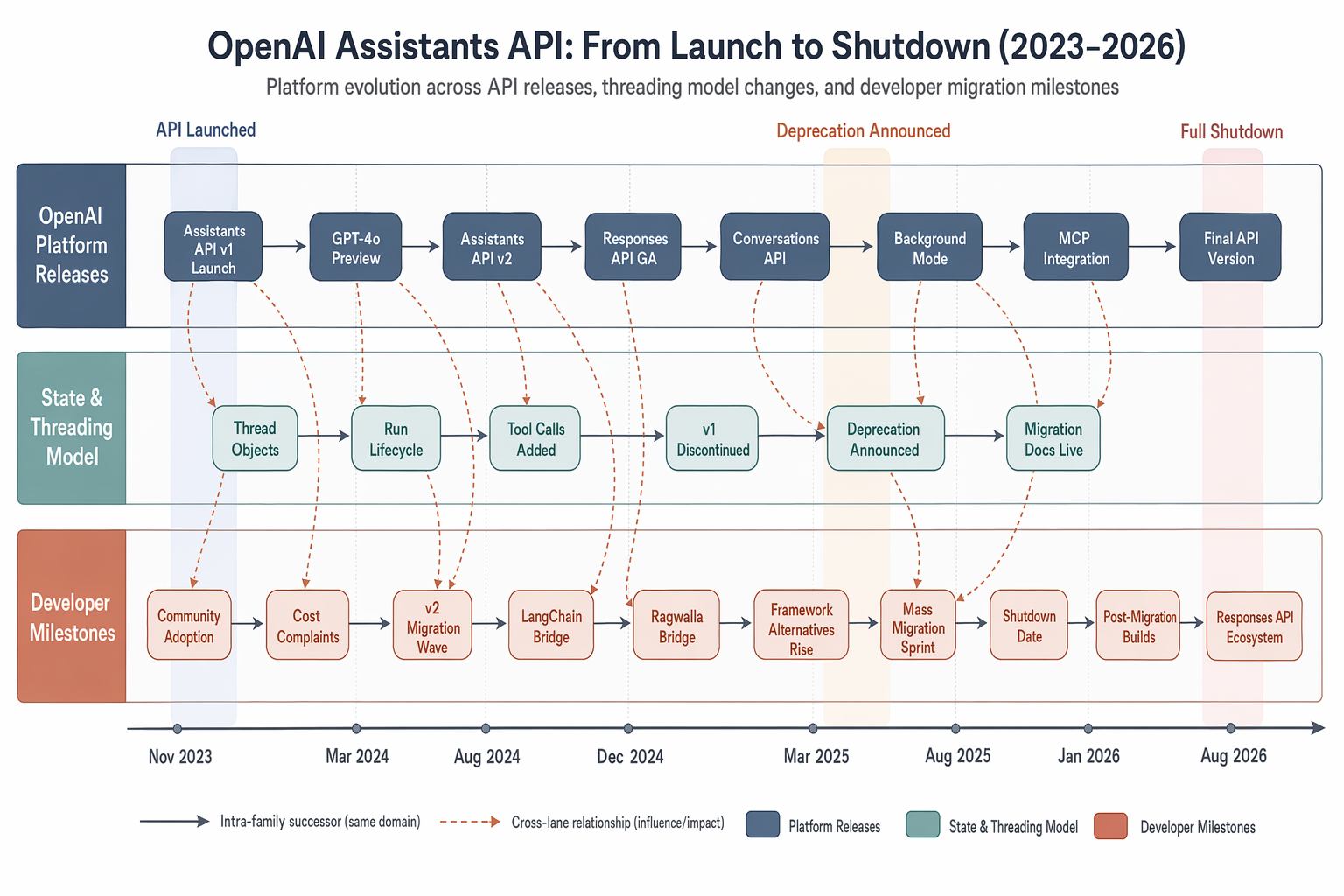
Yes, and the date is not negotiable. OpenAI issued the formal deprecation notice on 26 August 2025, and the full shutdown lands exactly twelve months later on 26 August 2026. After that timestamp, calls to Assistants endpoints return errors, not warnings. The v1 beta access was already pulled on 18 December 2024, leaving v2 as the only flavour anyone has been allowed to use for the past eighteen months. This is not a slow fade. This is a hard cutover with a fixed boundary, and the engineering effort to migrate is non-trivial. For context: daily OpenAI API calls passed 2.2 billion in 2025, and over 2.1 million developers are actively building on the platform. Even if Assistants represents a single-digit slice of that traffic, the absolute number of production systems pointed at those endpoints is enormous. Azure OpenAI customers carry the same deadline. The migration target there is the Microsoft Foundry Agents service, built on the same Responses API. Same plumbing, different doorway.
What exactly is the Assistants API and why did it matter?
The Assistants API arrived at OpenAI Dev Day in November 2023 as the platform's first opinionated answer to a question developers kept asking: "how do I build a stateful agent without writing my own orchestration layer". It bundled three objects (Assistants, Threads, Runs) and three built-in tools (Code Interpreter, File Search, Function Calling) into a single managed surface. The pitch was attractive. File Search handled retrieval-augmented generation up to 10,000 files per assistant without anyone touching a vector database. Code Interpreter gave the model a sandboxed Python environment for $0.03 per session. Threads persisted history server-side. For internal tools, support bots, and document Q&A, it worked. What it did not give you was control. State management was opaque, streaming was awkward, tool loops were hard-coded into Runs, and the architecture made one decision that would later become its biggest cost driver. The Assistants API mattered because it taught a generation of builders what the agent loop looks like. It is being retired because OpenAI now wants those same builders to write the loop themselves, with better primitives.
What replaces the Assistants API after August 2026?
The official answer is two APIs working together. The Responses API, launched in March 2025, handles the stateless request and response cycle. The Conversations API, launched on 20 August 2025, handles persistent state if you want it. The conceptual mapping is clean, even if the migration is not:
-
Assistants become Prompts (a reusable configuration block)
-
Threads become Conversations
-
Runs become Responses
-
Run Steps become Items
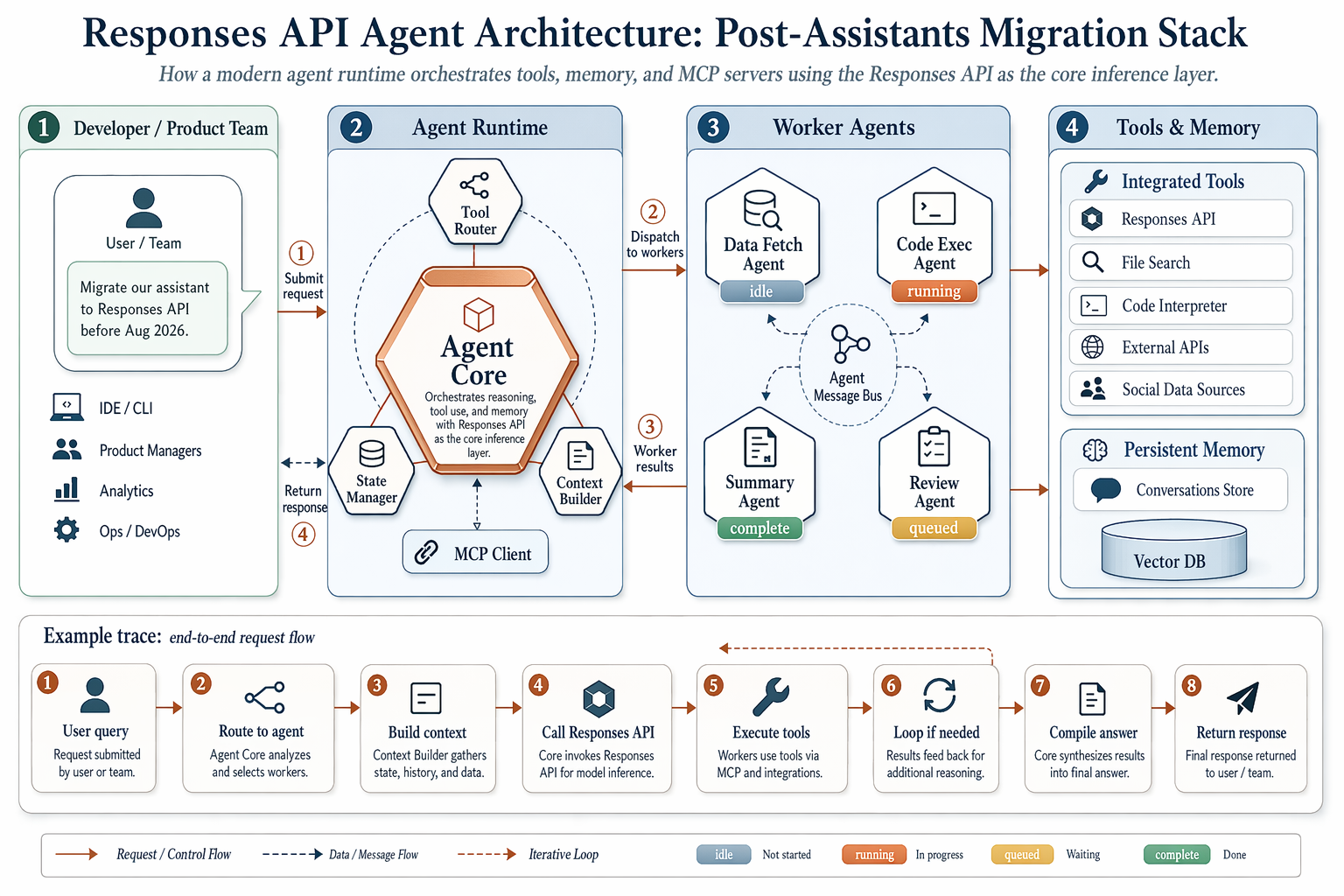
The key shift is philosophical, not cosmetic. The Assistants API was opinionated about state. The Responses API is opinionated about flexibility. Persistence is opt-in via Conversations, not bolted on by default. Tool loops are explicit, not magical. Background mode handles long-running asynchronous tasks that used to time out under Runs. Encrypted reasoning items address privacy concerns for regulated industries. The Responses API also added native support for remote MCP (Model Context Protocol) servers. That is a quiet but significant change. Instead of wiring every external service through bespoke Function Calling glue, you can point the API at a MCP endpoint and get tool access in the request itself. OpenAI also shipped an Agent SDK in early 2025 with first-class concepts for agents, handoffs (delegation between agents), guardrails, and sessions. If you want the higher-level opinions back, the SDK is where they live now.
How does the migration actually work in practice?
This is where teams get caught out. OpenAI has been blunt: there is no automated migration tool. Thread migration is manual. Backfill logic is your problem. And the documentation, while accurate, understates the scope of the engineering work involved. The practical sequence most teams are running:
First, recreate each Assistant as a Prompt in the OpenAI dashboard. Instructions, model, and tool configuration map across one-to-one. This is the easy bit and can usually be done in an afternoon.
Second, point new user sessions at the Conversations API. Any conversation that starts after the cutover goes straight into the new system. No legacy entanglement.
Third, decide the fate of historical Threads. There are three honest options. Archive them as cold storage (export to S3 or a database, drop from production). Backfill the important ones into Conversations using a custom script (slow, expensive, but preserves user history). Or accept the loss and prompt users to restart, which is fine for short-lived sessions but a disaster for long-term assistants.
Fourth, replace every Run call with a Responses call. This is where the explicit tool loop hurts. Code that previously did client.beta.threads.runs.create(.) and waited for status polling now needs to manage the loop, handle tool results, and decide when to stop. The logic is not complex, but it touches every code path that talks to the API. Estimate roughly one to four engineering weeks for a small production system. More for anything multi-tenant.

Why are Assistants API bills higher than developers expect?
This is the single most common complaint in post-deprecation Reddit threads. Get clear on the driver before assuming migration solves your cost problem. The Assistants API re-processes the entire thread on every message. Every prior message, every uploaded file, every retrieved chunk, all run through tokenisation on every turn. For a chatbot with ten user messages and a 200-page PDF attached, the cost curve does not stay flat. It compounds. Layer on the tool charges. Code Interpreter costs $0.03 per session, where each session stays warm for up to a hour. File Search costs $0.10 per GB per day for storage after the first free gigabyte, plus $2.50 per 1,000 tool calls. Both lines were widely missed in pre-launch capacity planning. The Responses API does not magically fix this. If you keep a long Conversation and re-send the same context, you still pay for it. What changes is control. With explicit state, you choose what enters each request. You can summarise old turns, drop attachments after first use, or run cheaper models for retrieval and reserve the flagship model for synthesis. Those are levers you did not have inside Runs. A second misconception worth burning down: you do not need a separate Assistant per user. One Assistant is a reusable configuration. Many users, one config, many Threads. Teams have been billed for thousands of redundant Assistants that should have been a single shared object. Check this before migration.
Should you migrate to the Responses API or go open-source?
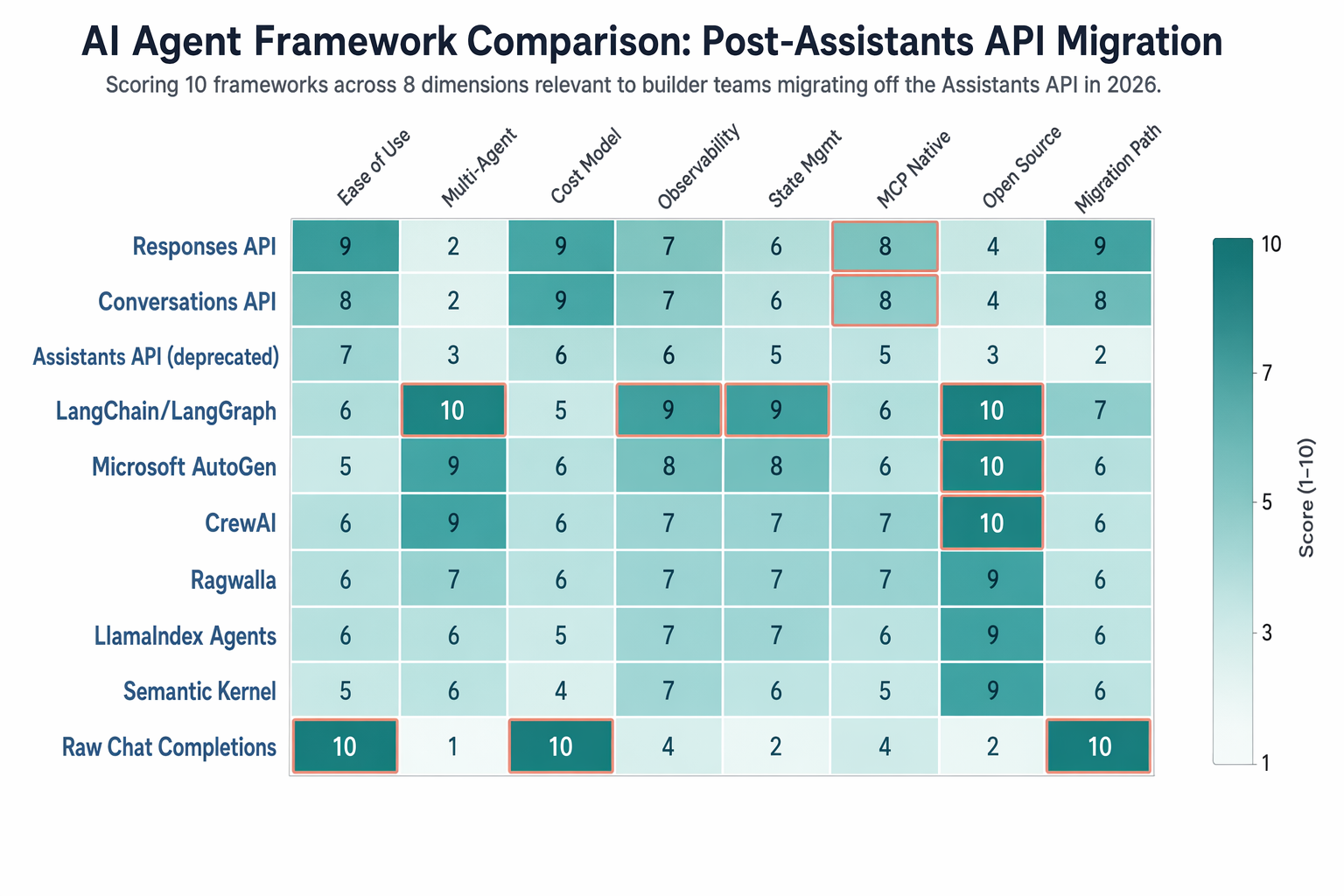
The honest answer depends on three variables: how much you trust OpenAI's roadmap, how much control you need, and how comfortable your team is with framework churn. Three paths are credible in 2026.
Path one: OpenAI Responses API plus Conversations API. Lowest friction if you are already deep in the OpenAI stack. Full feature parity is on the roadmap. Background mode and MCP support are real upgrades. Vendor lock-in is unchanged from the Assistants era, which is to say, significant.
Path two: open-source frameworks. LangChain plus LangGraph is the dominant choice for multi-agent orchestration, with LangSmith as the observability layer at $39 per user per month. Microsoft AutoGen is MIT-licensed and free at the framework level, with costs only from LLM calls. CrewAI is the role-based alternative most often compared to AutoGen. All three are model-agnostic, which is a real hedge if you might want to swap in Anthropic, Mistral, or a self-hosted Llama later. If the Anthropic route appeals, our guide to Claude agents covers the managed-agent equivalent of this migration.
Path three: wire-compatible alternatives. Ragwalla and similar services replicate the Assistants API surface, so existing code keeps working. This buys time. It does not solve the underlying architectural questions, but it is a defensible bridge for teams with shipping deadlines that do not align with August 2026. The choice is not "open-source good, vendor bad". It is "what do we want to own". OpenAI owns the model and the agent loop. LangChain or AutoGen makes you own the loop. Ragwalla lets you own neither for now and decide later.
How do experienced teams plan the migration timeline?
The deadline is roughly fifteen months out. That sounds generous, but it is not, especially for teams running multiple assistants in regulated environments. A realistic timeline:
Months one to two: audit. Inventory every Assistant in production, every Thread under active use, every File Search index. Catalogue token spend per assistant and identify the cost outliers.
Months three to four: prototype the Responses plus Conversations migration on the lowest-risk assistant. Measure latency, cost, and developer experience against the existing system. Decide whether to stay on OpenAI rails or branch to a framework.
Months five to eight: migrate production assistants in priority order. Keep the old endpoints live and dual-write for a rollback window of at least four weeks.
Months nine to twelve: handle the long tail. Backfill historical Threads if the product requires it, deprecate old code paths, and validate the savings against the new architecture. The teams getting this right are not the ones with the most engineering capacity. They are the ones who started before the panic.
What does this shift mean for AI agent builders in 2026?
The Assistants API shutdown is not just a deprecation. It is a signal about where the industry is going. Three things are now obvious that were debatable a year ago.
First, the agent loop is the product, not a feature. OpenAI is asking developers to take ownership of it because the abstraction was leaking value and constraining what real systems needed to do. Every serious agent platform, OpenAI's own SDK, LangGraph, AutoGen, CrewAI, now exposes the loop. The era of "hidden orchestration" is closing.
Second, tool access is the new differentiator. The Responses API's native MCP support is the loud version of a quiet trend: agents are only as useful as the systems they can reach. Function Calling alone is not enough at scale. MCP servers, structured tool catalogues, and unified data envelopes are how teams keep agents fed without rebuilding integrations every quarter.
Third, real-time external signal is becoming part of the agent's working memory. Documentation tells you what an API does. Community discussion tells you what is breaking, who is migrating, and which framework is actually winning in production. This is where social and developer-platform data, the kind aggregated through tools like SocialCrawl across Reddit, Hacker News, X, GitHub issues, and 38 other platforms in a single unified envelope, becomes useful as a tool inside the agent itself, not just as research before a meeting. An MCP-ready endpoint that returns 43 platforms in one call is far closer to how agents actually want to consume the world than a per-platform scrape stack.
Concretely, that is one tool call. An agent working the migration can pull live discussion from Reddit, Hacker News, and GitHub in a single request instead of maintaining three scrapers:
curl -s "https://www.socialcrawl.dev/v1/search/everywhere?query=OpenAI+Assistants+API+migration&sources=reddit,hackernews,github&lookback_days=30" \
  -H "x-api-key: $SOCIALCRAWL_API_KEY"
The /v1/search/everywhere endpoint fans the query across every source in parallel, fuses and reranks the results, and returns one unified envelope the agent reads directly. It is a flat 20 credits per call. That is the gap between an agent that knows what shipped last week and one that only knows what the docs said last year.
The global AI API market was valued at $48.50 billion in 2024 and is projected to hit $63.21 billion in 2025, with a 31.3% compound annual growth rate through 2030. That growth is not flowing to the most opinionated platforms. It is flowing to the ones that give builders control plus good defaults. The Assistants API tried to be the former without the latter, and the Responses API is the correction. Build accordingly. The next agent platform you commit to will probably also be deprecated. The fundamentals you learn during this migration, explicit state, explicit tool loops, explicit cost control, will outlast every wrapper.
FAQ
Is the OpenAI Assistants API still worth learning in 2026? For new projects, no. The API is deprecated with a hard shutdown on 26 August 2026. Learn the Responses API plus Conversations API instead. They offer more flexibility, better cost control, and represent OpenAI's official forward direction.
What is the difference between the Assistants API and the Responses API? The Assistants API managed state server-side using Assistants, Threads, and Runs. The Responses API is stateless by default, with optional server-side state via the separate Conversations API. You get explicit control over tool loops, plus support for MCP servers, background mode, and encrypted reasoning items. The conceptual mapping is Assistants to Prompts, Threads to Conversations, Runs to Responses.
How do I migrate existing Threads to the new Conversations API? There is no automated migration tool. OpenAI recommends migrating new user sessions to Conversations first, then backfilling historical threads as needed. Start by recreating Assistants as Prompts in the dashboard, then rewrite your Run calls to use Responses endpoints. Treat thread backfill as a separate workstream.
What does the Assistants API cost, and why are bills higher than expected? Pricing includes model token costs plus Code Interpreter at $0.03 per session, File Search storage at $0.10 per GB per day after the first free gigabyte, and tool calls at $2.50 per 1,000 calls. The hidden cost driver: every user message re-processes the entire thread, including all uploaded file content, so token usage compounds with conversation length.
What are the best alternatives to the Assistants API in 2026? Three paths. One, migrate to OpenAI's Responses API plus Conversations API, the official route. Two, adopt an open-source framework such as LangChain with LangGraph or Microsoft AutoGen, both model-agnostic. Three, use a wire-compatible alternative like Ragwalla that replicates the Assistants interface as a bridge while you decide.
Related posts

Best Multi-Platform Social Search API: 129 Rows, 4 Credits
Best multi-platform social search API: one coldplay call returned 129 rows from TikTok, Instagram, YouTube, and Reddit. Four sources were billed 1 credit each.

LinkedIn profile API: one call for the whole profile
One LinkedIn profile API call on Bill Gates's public URL returned 40,702,334 followers, 3 jobs, and 2 schools for 5 credits. The 50 posts were a separate call.

One Country Code, This Week: Social Media Trends API
Social media trends API, 30 credits: US breakout post, three sounds, three hashtags, three Google searches. Pinterest, Apple Music, Product Hunt are separate.