Competitor Intelligence in 2026: How B2B Teams Win Deals
Competitor intelligence in 2026: what it is, the eight signal sources that matter, the modern CI stack, and how small B2B teams win without enterprise tools.

Sixty-eight percent of B2B sales deals now involve at least one direct competitor, yet the average sales team rates itself just 3.8 out of 10 for competitive preparedness. That gap costs organisations between two and ten million dollars a year in winnable deals, per Crayon's 2025 State of Competitive Intelligence Report. Competitor intelligence used to be a quarterly slide deck. In 2026 it is a real-time discipline, and the teams getting it right treat signals, not screenshots, as the unit of work.
What is competitor intelligence in 2026?
Competitor intelligence is the continuous practice of gathering, analysing, and activating information about specific named rivals so that sales, product, and marketing can make better decisions faster. The keyword is activation. Collecting data is no longer the hard part; turning it into a usable answer the moment a rep walks into a deal is.
The category has matured significantly. Gartner renamed it from "Competitive Intelligence Tools" to "Competitive and Market Intelligence Platforms" in 2025, signalling that this is now an enterprise platform purchase, not a side project. By 2026, Gartner expects roughly 40 percent of technology and service providers to use commercial CI tools, up from about 10 percent only a few years ago. The competitive intelligence tools market is projected to reach 1.46 billion dollars by 2030, growing at nearly 20 percent annually, per Mordor Intelligence.
Modern CI covers product changes, pricing shifts, messaging, win/loss patterns, hiring trends, patent filings, analyst coverage, and the messy social signal layer where customers actually voice opinions. A programme that only watches competitor websites is monitoring roughly 20 percent of the available signal.
How is competitor intelligence different from market research?
Market research answers "what is happening in this category" at the macro level: total addressable market, buyer segments, regulatory shifts, secular trends. Competitor intelligence answers "what is this specific rival doing right now and what should we do about it." The two practices share tools and analysts, but the cadence and the consumers differ sharply.
Market research lands as a quarterly report read by strategy leadership. Competitor intelligence lands as a Slack alert or battlecard update read by an account executive 27 minutes before a discovery call. One informs three-year planning; the other shapes this afternoon's conversation. Mature teams run both, often through the same platform.
The clearest signal of category seriousness is the funding flowing in. SoftwareOne completed its 1.4 billion dollar acquisition of Crayon in July 2025. AlphaSense surpassed 500 million dollars in ARR in October 2025 and now serves 85 percent of the S&P 100. Klue acquired the agentic AI platform Ignition in September 2025 and now serves over 250,000 users.
Which platforms hold the signals competitors actually leak?
Eight source types matter, and they are not equally easy to access.
The public web (pricing pages, blogs, press releases, changelogs) is the easy layer; every CI tool monitors it. Review sites such as G2 and Capterra add structured buyer feedback. Job postings reveal product roadmap bets months before a launch, because a sudden cluster of machine learning engineering hires almost always precedes an AI feature announcement. Patent filings extend that signal further out. Analyst reports from Gartner and Forrester provide third-party validation. Sales call transcripts surface competitor mentions from real buyer conversations, which is why conversational intelligence platforms have become a core CI input.
Then there is the layer that breaks most programmes: social platforms. The 1,500-upvote Reddit thread complaining about a competitor's onboarding. The Hacker News discussion dissecting an acquisition's integration mess. The TikTok comments comparing pricing changes in real time. This is where the highest-signal conversations live, and also where Google's index is weakest and where most enterprise CI tools have only token coverage. Tools like SocialCrawl exist to bridge that walled-garden blind spot, returning competitor sentiment from 43 platforms in a single normalised envelope rather than forcing a per-platform scraper or a 50,000 dollar enterprise contract. To pull out the posts where someone says they already left a rival, see brand switching signals from public posts.
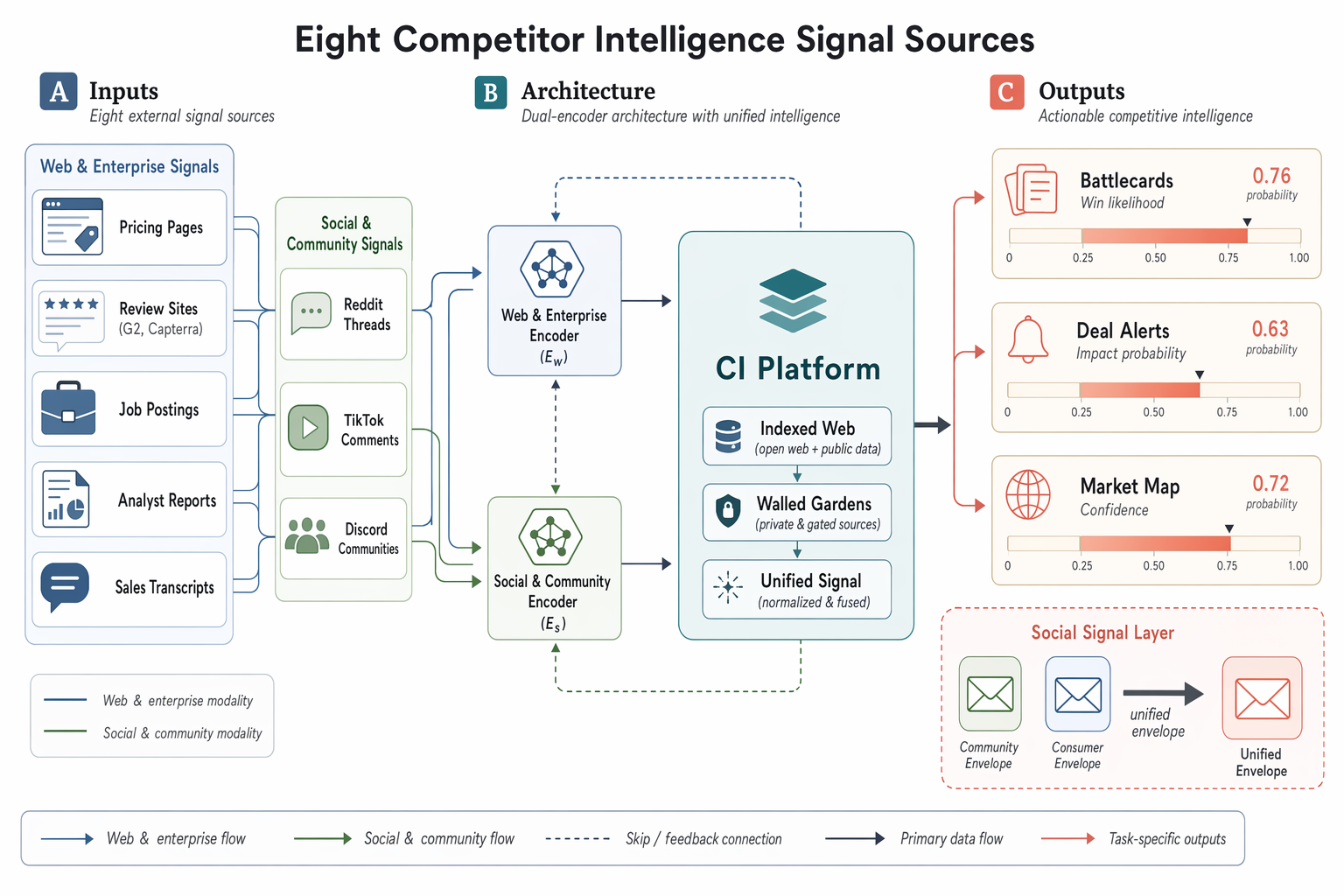
A 2026 Reddit thread in r/ProductMarketing put it bluntly: AI search tools only see public data. The strategy has to cover the non-public layer too.
How do AI agents change competitor intelligence workflows?
AI adoption inside CI teams jumped 76 percent year on year, according to the Competitive Intelligence Alliance, with 60 percent of teams now using AI daily. That shift is reshaping scope, speed, and the role of the analyst.
On scope, agentic AI lets a single platform process volumes that previously required a team. Contify covers 700,000-plus companies across over a million curated sources in 117 languages, routed through its Athena agentic AI engine that extracts more than 30 business facts per entry. ZoomInfo processes a billion buying signals a month. No analyst was ever going to read that volume by hand.
On speed, the relevant data point is the 27-minute window. When a competitor was mentioned in discovery and the rep received battlecard intel within 27 minutes, win rates jumped from 32 percent to 67 percent. Klue's Compete Agent, launched as part of the Ignition acquisition, is built around this exact moment, delivering real-time competitive deal intelligence directly to sellers during active deals.
The analyst's role has not shrunk; the bar has risen. AI handles the structured public web well. It still cannot see what customers say behind login walls, in private Discords, or in TikTok comment threads. Analysts who curate the social signal layer and own activation are more valuable, not less. The ones who only summarised press releases are being absorbed into product marketing.
What does a modern competitor intelligence stack look like?
There is no single right answer, but the 2026 reference architecture has four layers.
The dedicated CI layer holds Crayon, Klue, or Kompyte. Crayon and Klue land at roughly 20,000 to 40,000 dollars a year. Kompyte, owned by Semrush, starts at 300 dollars a year and is the most credible budget entry point. Klue is currently a G2 Leader in four categories simultaneously.
The market intelligence layer covers strategic context. AlphaSense, valued at four billion dollars in its June 2024 Series E, indexes SEC filings, earnings transcripts, expert calls, and equity research. Contify is the strongest option for global, multilingual coverage.
The sales and signal layer adds activation. ZoomInfo and 6sense pump intent into the CRM; 6sense alone processes a trillion signals a day. Gong analyses 300-plus signals per call and ties competitor mention tracking to an 82 percent win rate lift. Clozd handles structured win/loss interviews and is used by 43 percent of CI professionals in that category.
The social signal layer is the newest and the one most teams underbuild. SimilarWeb and Semrush cover digital traffic and SEO; Brandwatch covers brand monitoring at enterprise scale and price; SocialCrawl covers the cross-platform social opinion layer at a credits-only cost, returning 43 platforms in one query through a single x-api-key header.
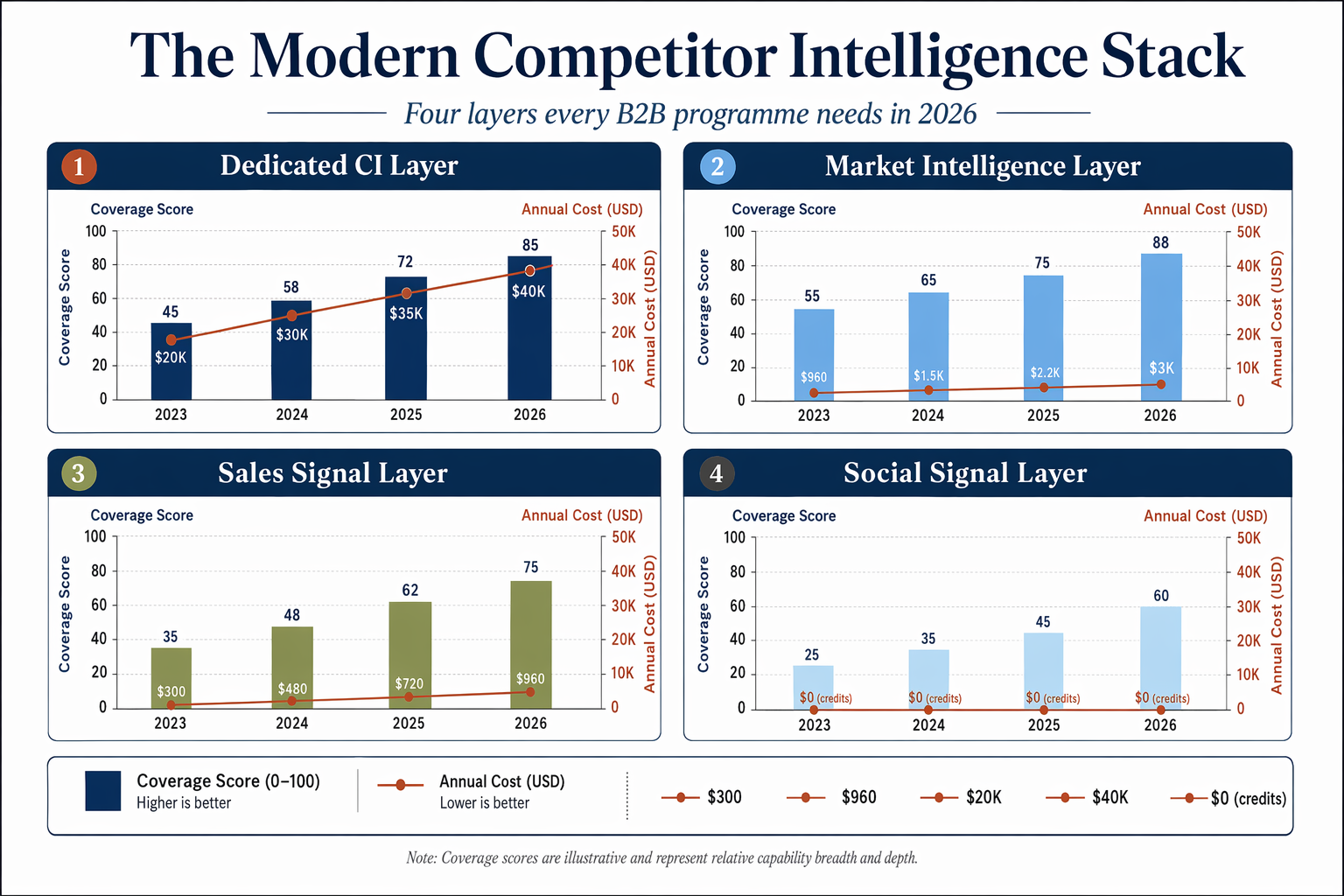
The mistake most programmes make is overinvesting in the dedicated CI layer and skipping the social signal layer entirely. Customers do not write product reviews on competitor websites. They write them on Reddit, on TikTok, in Slack communities, in Discord servers. A stack that ignores those venues is reading vendor claims, not customer opinions, with one eye closed.
How do you set up a competitor intelligence workflow without enterprise tools?
A starter stack under 1,500 dollars a year can produce real competitive lift if the workflow is right.
Start with Kompyte Essentials at 300 dollars a year for automated competitor website monitoring. Add Google Alerts as a free baseline for press. Layer LinkedIn Sales Navigator Core at 960 dollars a year for personnel and account signal.
For the social layer, the cheapest credible option is a unified social API with credit-based pricing. SocialCrawl's free tier gives 100 credits with no card, and the Growth plan lands at 49 pounds for 32,000 credits with no subscription, enough to keep a small team in continuous competitive listening for months. The point is not to replace Crayon for an enterprise team; it is to give a five-person product marketing team source posts, not summaries, on what customers are actually saying.
Three rules separate working programmes from theatrical ones. Update battlecards monthly at minimum; teams that do see up to a 59 percent win rate lift. Deliver intelligence into the surface where reps already work, which usually means CRM, Slack, or email. And measure activation, not collection. Only 26 percent of CI teams say reps use battlecards as much as they would like, and 33 percent do not measure usage at all. That is the real bottleneck, per Autobound's competitive analysis.
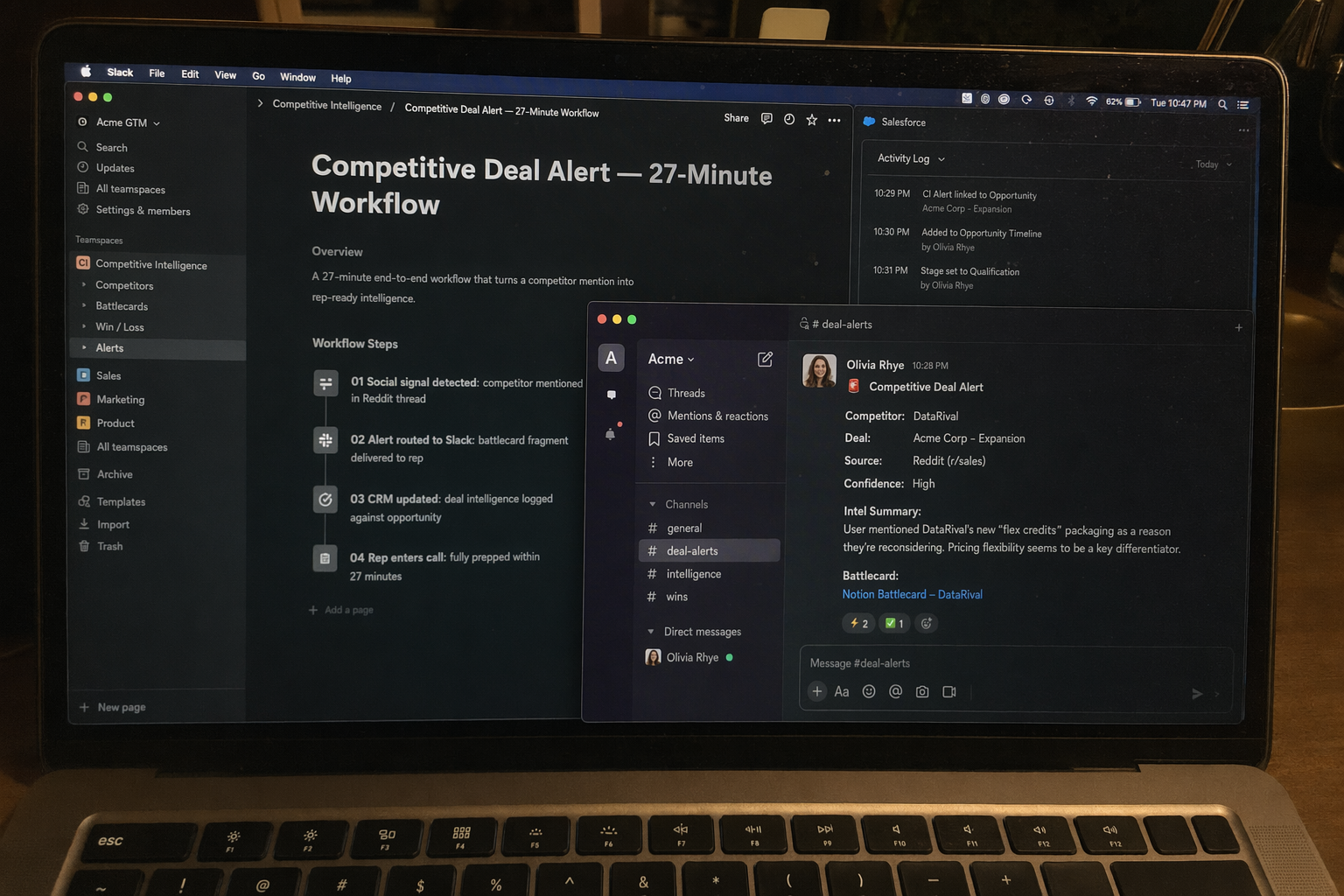
The 27-minute window is the goal. From a competitor mention surfacing in a call recording or a social post, to a relevant battlecard fragment landing in the rep's Slack DM, the entire pipeline should run in under half an hour. Anything longer and the deal has already moved on.

What are the most common competitor intelligence mistakes?
Four patterns recur across failed programmes.
Mistaking competitor websites for competitor reality is the most common. The pricing page is a sanitised story; the Reddit complaint thread is the unsanitised one. Programmes that only watch the public web are reading vendor claims, not customer opinions.
Collecting without activating comes second. Sixty-eight percent of competitive battlecards are never used by sales teams. The fix is workflow integration, not more content.
Treating CI as a product marketing silo is the third failure mode. The highest-performing programmes are cross-functional: sales contributes field intelligence, product uses CI for roadmap decisions, customer success uses it for retention plays. If only one team contributes and consumes, the programme creates blind spots that cost deals.
Assuming general-purpose AI search is enough is the fourth. ChatGPT and Perplexity cannot access Reddit threads that require login, Discord servers, or live social data. They summarise what is indexed; they do not see what is actually being said.
Where is competitor intelligence heading?
Three shifts will define the next two years.
Agentic CI moves from feature to default. Klue's Compete Agent and Contify's Athena are early signals, but by 2027 every dedicated CI platform will ship an agent layer that monitors, summarises, and routes competitive intelligence into the seller's workflow autonomously.
The walled-garden bridge becomes a category. As AI search turns the indexed web into a commodity, advantage shifts to data sources AI search cannot reach: Reddit, Discord, TikTok comment threads, private Slack communities. Tools that unify access through enterprise contracts or developer APIs will absorb a growing share of the CI budget.
The role of the standalone CI analyst will compress. AI handles structured collection. Product marketing absorbs curation. What grows is the senior strategist who interprets the social signal layer, runs win/loss programmes, and owns activation into sales. The organisations compounding advantage through 2027 will read source posts, not summaries, and measure win rates, not battlecard counts.
Frequently asked questions
What is the difference between competitor intelligence and market intelligence?
Competitor intelligence focuses on specific named competitors, tracking product changes, pricing, messaging, and win/loss outcomes. Market intelligence is broader and covers trends, buyer segments, regulatory shifts, and total addressable market. Most mature CI programmes combine both, using dedicated CI platforms such as Klue or Crayon for competitor-specific tracking and market intelligence platforms such as AlphaSense or Contify for macro strategic context.
How do I get started with competitive intelligence on a small budget?
A starter stack for under 1,500 dollars a year works well. Kompyte Essentials at 300 dollars a year covers automated competitor tracking, Google Alerts is a free baseline for news, and LinkedIn Sales Navigator Core at 960 dollars a year covers personnel and account signals. For the social signal layer, a credit-based unified social API such as SocialCrawl gives small teams real customer voice data without an enterprise contract.
What data sources matter most for competitor intelligence?
Eight source types matter: public web (pricing pages, blogs, press releases), review sites (G2, Capterra, Trustpilot), social media (Reddit, LinkedIn, X, TikTok), job postings (which reveal product roadmap bets), analyst reports (Gartner, Forrester), sales call transcripts where buyers mention competitors, patent filings, and walled-garden community platforms where the most candid feedback lives. Programmes that cover all eight beat programmes that only watch competitor websites.
How often should competitive battlecards be updated?
Monthly at minimum. Crayon's research shows monthly updates correlate with up to a 59 percent win rate lift, and fast-moving categories often refresh weekly. The bigger problem is activation, not freshness: 68 percent of battlecards are never used regardless of update cadence, so the priority is delivering intelligence into Slack or CRM rather than producing more content nobody reads.
Can AI replace a dedicated competitive intelligence analyst?
Partially, but not for the social signal layer. AI search tools only access public, indexed data. The highest-signal competitive conversations happen in walled-garden platforms such as private Reddit communities, Discord servers, and TikTok comment sections, where no AI search engine has visibility. AI excels at monitoring structured public web content and summarising it; human analysts are still required to interpret the social signal layer and to own activation into sales workflows.
Related posts

Best Multi-Platform Social Search API: 129 Rows, 4 Credits
Best multi-platform social search API: one coldplay call returned 129 rows from TikTok, Instagram, YouTube, and Reddit. Four sources were billed 1 credit each.

LinkedIn profile API: one call for the whole profile
One LinkedIn profile API call on Bill Gates's public URL returned 40,702,334 followers, 3 jobs, and 2 schools for 5 credits. The 50 posts were a separate call.

One Country Code, This Week: Social Media Trends API
Social media trends API, 30 credits: US breakout post, three sounds, three hashtags, three Google searches. Pinterest, Apple Music, Product Hunt are separate.