AI Agent Frameworks in 2026: What Actually Ships
LangGraph, CrewAI, Mastra, and Pydantic AI compared on real production numbers: which AI agent framework developers should actually pick in 2026, and why.

The agent framework conversation has shifted. In 2024 it was a feature comparison. In 2026 it is a deployment audit. Klarna's customer support bot, built on LangGraph, now handles two-thirds of all inquiries and does the work of 853 employees, saving the company $60 million a year. JP Morgan reports 95% faster research retrieval. AppFolio doubled response accuracy. Behind those numbers sits a noisier story: a 66-point Hacker News thread titled "Sick of AI Agent Frameworks", and a 51-upvote Reddit post in r/AI_Agents arguing that 90% of agentic projects would be better off as simple prompt chains.
Both things are true. Frameworks are paying for themselves at enterprise scale, and developers are tired of the abstraction churn. This guide is for the engineer who has to pick one anyway.
What is an AI agent framework, really?
An agent framework sits between your application and the raw model API. It owns the loop: plan, call a tool, evaluate the response, retry, hand off, persist state, repeat. A direct call to Claude or GPT gives you one response. A framework gives you a controllable graph that can run for minutes, recover from a 429, and resume on a checkpoint.
The mental models differ. LangGraph treats the agent as a directed graph of nodes and edges. CrewAI treats it as a team of role-specialists with a manager. AutoGen treats it as a multi-party conversation. Pydantic AI treats it as a typed function with structured outputs. Mastra treats it as a TypeScript workflow with first-class tracing. Same underlying problem, very different idioms -- and the idiom you pick shapes your debugging surface for the next two years.
This is the first useful frame: agent frameworks handle orchestration, not data access. They route, schedule, and retry. They do not unlock the platforms your agent actually needs to read. That distinction matters more in 2026 than a year ago, and we will come back to it.
Which framework is winning in production right now?
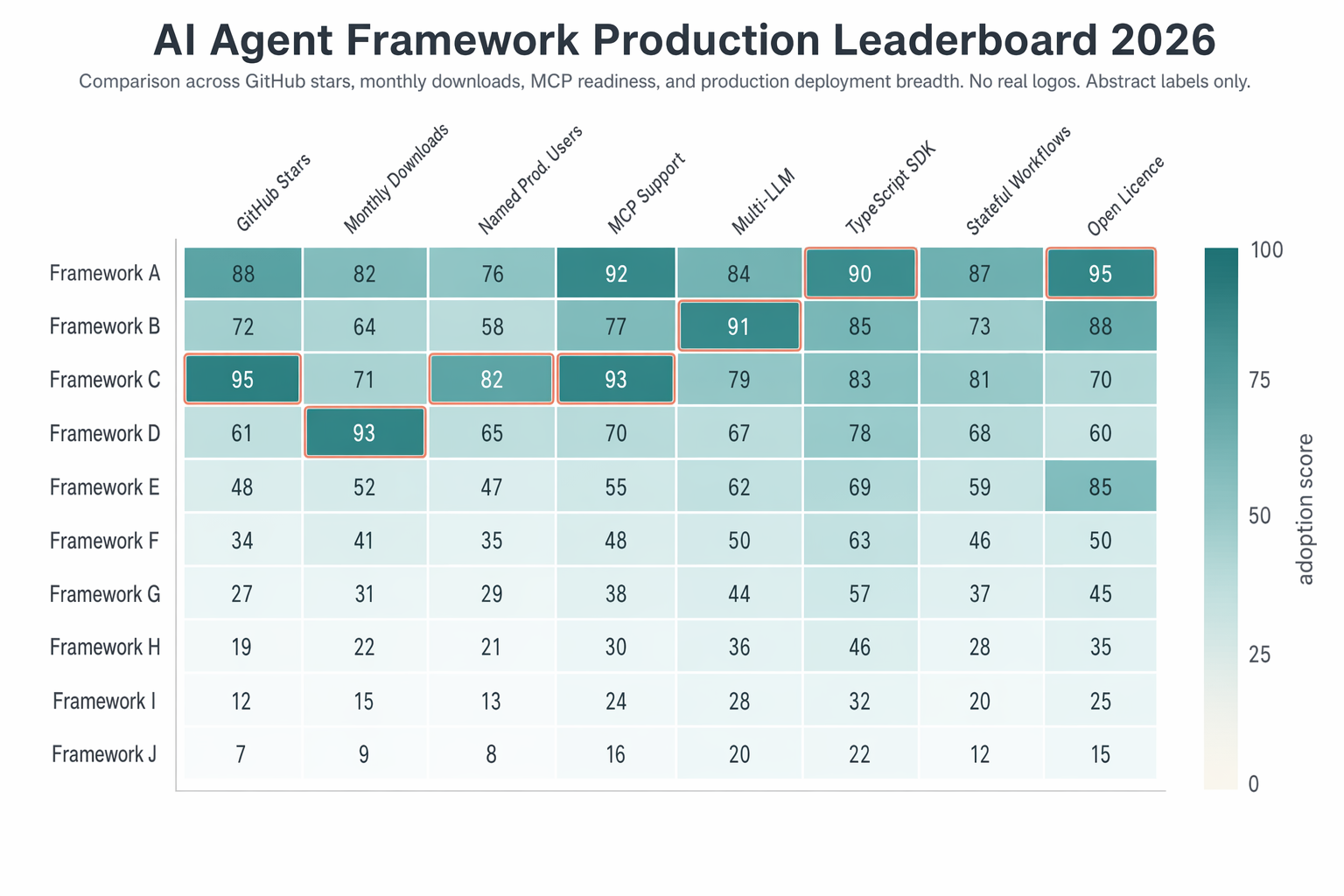
By download volume the answer is unambiguous. According to pypistats.org, the LangChain ecosystem records 235 million monthly PyPI downloads as of October 2025 and 237.4 million by May 2026. LangGraph alone clocks 34.5 million monthly downloads with 24,800 GitHub stars and roughly 400 production deployments, including Cisco, Uber, LinkedIn, BlackRock and JPMorgan. The Firecrawl 2026 framework review calls it the most-deployed stateful agent framework in the open-source category, and the case studies back that up.
CrewAI is the volume leader for prototyping. It raised an $18M Series A and reports use across 60% of Fortune 500 companies, with 44,300 GitHub stars and 5.2 million monthly downloads. AutoGen has 54,600 stars but in October 2025 Microsoft merged it with Semantic Kernel into the unified Microsoft Agent Framework. The original AutoGen repo is now maintenance-only, and any new project starting on it in 2026 is starting on a deprecated path.
Then there are the upstarts. Google's Agent Development Kit, announced in April 2025, hit 17,800 stars and 3.3 million monthly downloads inside its first year and now powers Google Agentspace. The OpenAI Agents SDK, released March 2025, reached 19,000 stars and 10.3 million monthly downloads despite supporting 100-plus LLMs from competitors. (If you are migrating off the deprecated Assistants API, the shutdown migration guide maps the realistic paths.) Mastra, the TypeScript-first framework backed by Y Combinator with a $13M seed from Paul Graham and Guillermo Rauch, hit version 1.0 in January 2026 and supports 81 providers across 2,436+ models. Replit's Agent 3, built on Mastra, lifted task success rates from 80% to 96% across thousands of daily coding sessions. Marsh McLennan deployed a Mastra-powered search tool to 75,000 employees.
Dify, while not strictly a code framework, leads the entire category in stars at 129,800. It is a low-code visual builder that wraps the same orchestration patterns for non-engineering teams.
Should you start with CrewAI or LangGraph?
For most developers in 2026, the honest answer is: start with CrewAI, plan to migrate to LangGraph.
CrewAI's role-based abstraction (researcher, writer, reviewer, manager) maps cleanly to how product managers describe what they want. A working multi-agent prototype takes between two and four hours from a fresh repo. The friction shows up later, when you need durable state, human-in-the-loop checkpoints, or an audit trail for compliance. That is LangGraph territory.
LangGraph is harder to pick up because it forces you to think in graphs and state machines from day one. It pays back in production. The LangGraph Klarna case study is the canonical reference: 853 employee-equivalents of work, $60 million in annual savings, and an explicit graph that engineering can reason about when something breaks at 03:00. LinkedIn's SQL Bot, which converts natural language to SQL in production, is built on the same primitives.
If your team is Python-first and writing structured-output workloads -- classification, extraction, document Q&A -- Pydantic AI is the quietly correct choice. The Pydantic team understands type safety and testability better than most in this space, and structured agent responses you can validate with a schema beat unstructured chat in every regulated environment.
Two patterns to plan for: pick the framework that matches your team's existing language, and write your tool layer once with your own interface so swapping frameworks costs days, not weeks.
What about TypeScript teams, is Mastra ready?
Yes. The TypeScript agent gap closed in late 2025 and Mastra is the reason. Replit moved Agent 3 to it. SoftBank uses it. The framework hit version 1.0 in January 2026 with built-in observability, evals, and a deployment story for Vercel and Cloudflare Workers that matches JavaScript stack expectations.
The trade-off is ecosystem maturity. LangGraph has more case studies, more middleware, and more conference talks. Mastra has cleaner DX for Next.js and Node teams who do not want to maintain a Python service alongside a TypeScript app. If you are already deploying Edge functions and your data layer is TypeScript end-to-end, Mastra is the path of least resistance.
The Claude Agent SDK from Anthropic is worth knowing if you are already deep on Claude. Renamed from Claude Code SDK in September 2025, it ships the same infrastructure as Claude Code itself: sandboxed shell, file editing, native MCP tool support. The trade-off: Anthropic-only by design.
How does the Model Context Protocol change framework choice?
The Model Context Protocol, launched November 2024, is now the universal connector for agent tools. Backed by Anthropic, OpenAI, Google, Microsoft, AWS, Block, Cloudflare and Bloomberg, MCP standardises how agents discover, authenticate against, and invoke external systems. Think USB-C, but for tools.
This collapses one of the historical reasons to pick a framework. In 2024 you might have chosen LangChain because it had the integration you needed. In 2026, if a tool ships an MCP server, every MCP-compatible framework can use it. The decision moves from "what plugs in" to "what runs reliably under load".
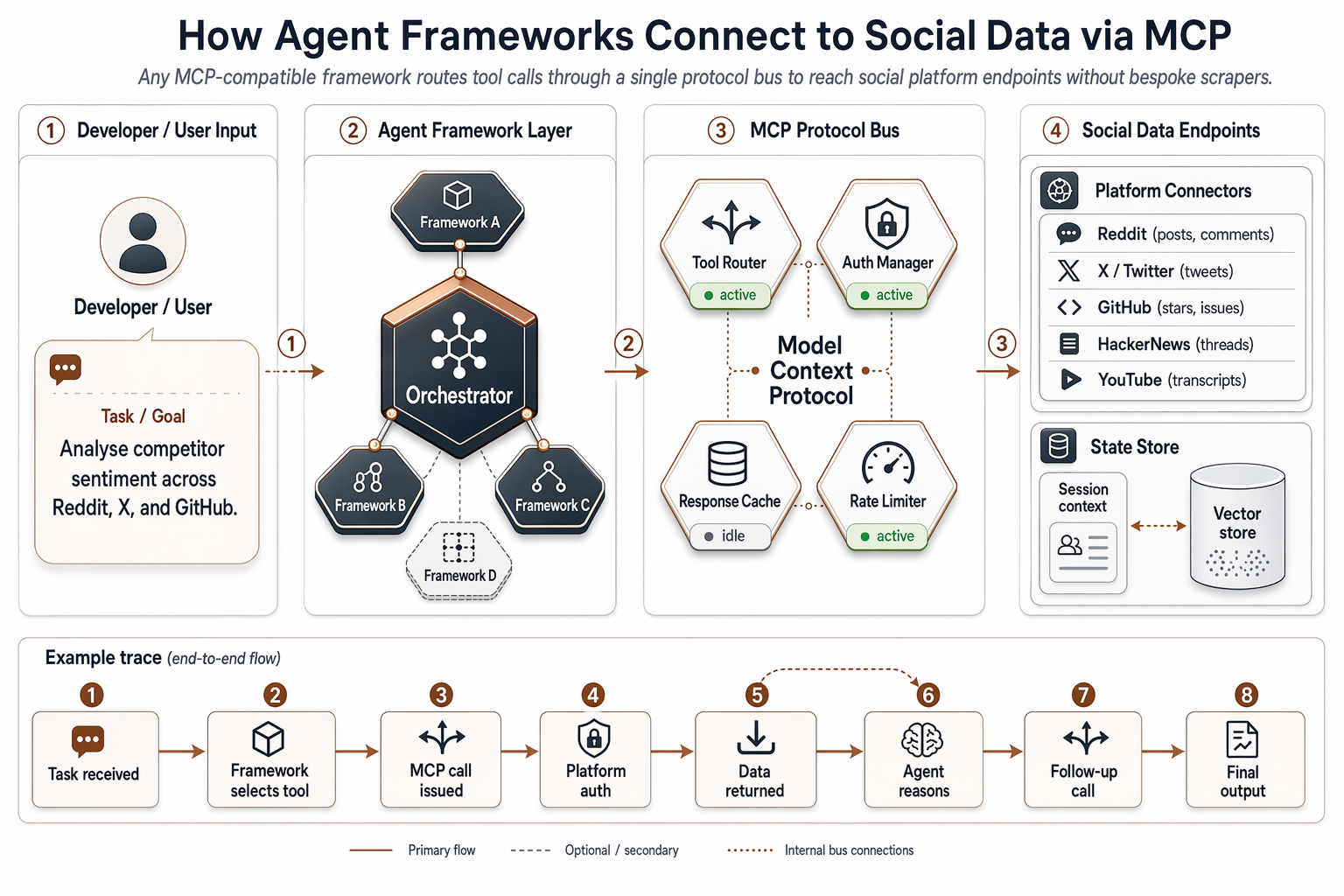
The practical implication: prefer tools with MCP servers. Prefer frameworks with first-class MCP clients. The list grows weekly, and any tool vendor still asking you to write a bespoke integration in 2026 is signalling that they are behind.
What do AI agent frameworks still get wrong?
Five things, ranked roughly by how often they cause production incidents.
First, the autonomy myth. Agents do not "think". They execute developer-defined tools inside developer-defined permission scopes. What looks like decision-making is constrained search across a fixed action space. Treating an agent as autonomous is how you ship something with no guardrails.
Second, more tools makes agents worse, not better. Once you give an agent a dozen tools it starts choosing the wrong one, passing wrong parameters, or skipping a tool entirely. Start narrow. Add a tool only when a missing capability is the actual blocker.
Third, framework choice is not a "we can swap later" detail. State management, debugging, observability and failure modes diverge sharply between LangGraph, CrewAI, AutoGen and Pydantic AI. A 2025 Cleanlab survey of 1,837 engineering and AI leaders found 70% of regulated enterprises replace at least part of their AI agent stack every three months. Switching costs are real, and budgeting for one rewrite per quarter is more honest than pretending you picked the perfect framework on day one.
Fourth, demos lie. MIT research cited by Airbyte found only 5% of AI implementations successfully transition from pilot to production. The gap between "it worked in the notebook" and "it survives a real customer load" is months of work on retries, fallbacks, evals, and the ugly edge cases nobody puts in a YouTube demo.
Fifth, and most relevant for this audience: frameworks do not solve the data access problem. They solve orchestration. The minute your agent needs to read what people are actually saying on Reddit, X, Hacker News, TikTok or YouTube, you discover the framework has no opinion on walled gardens. That is a separate engineering project, and most teams underestimate it by an order of magnitude.
How do agents read social platforms when frameworks cannot?
This is where the framework comparison breaks down and the data layer takes over.
Each social platform is a fortress. Reddit has its own auth, rate limits and ToS. X has another. TikTok has 26 distinct endpoints when you actually map them, more than any other platform. Hacker News has no first-class API for the searches you actually want. YouTube returns a different shape of data again. Building one bespoke integration per platform is a maintenance project that breaks weekly and a hiring problem that compounds.
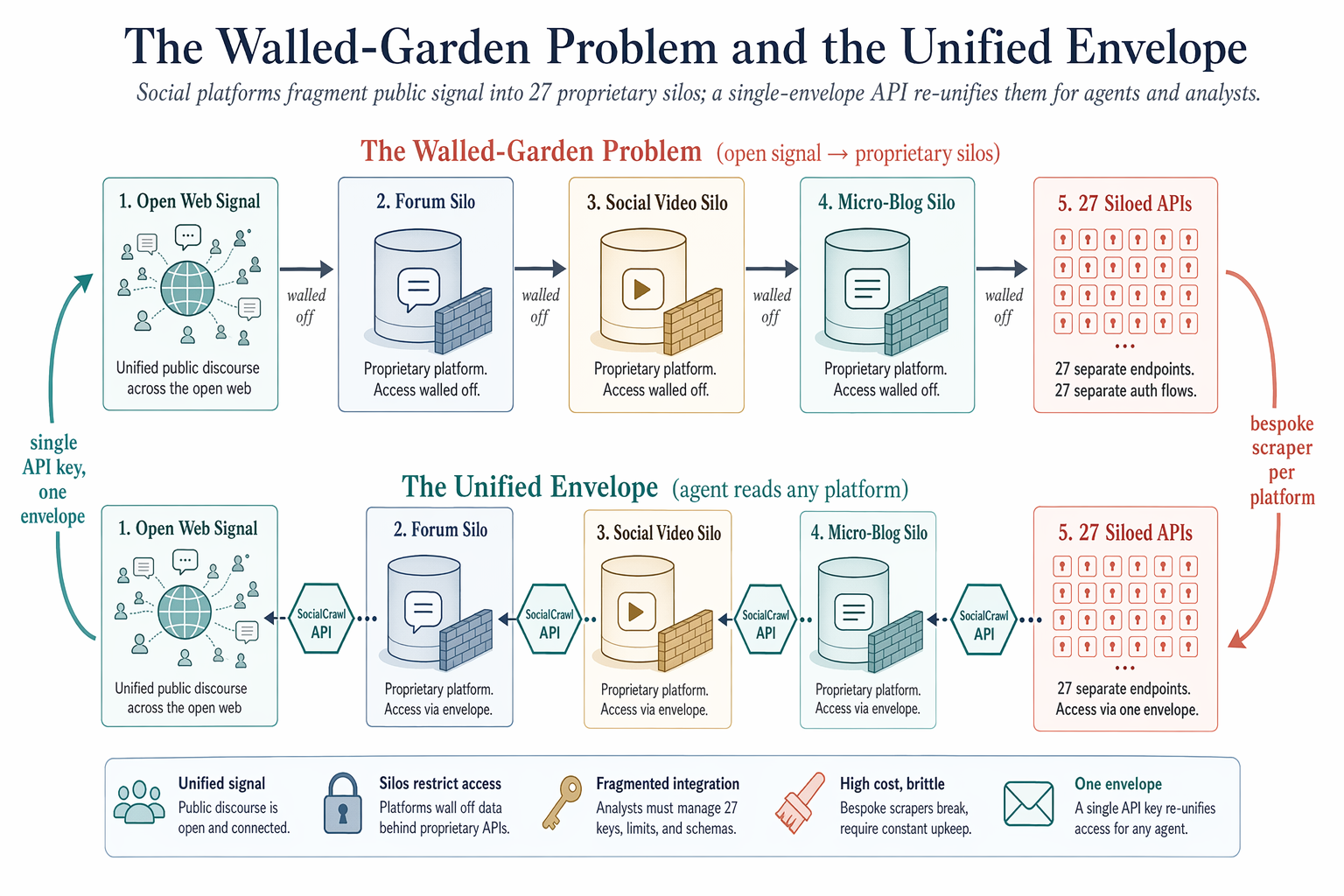
SocialCrawl is the bridge layer for this. Forty-two platforms, 321 endpoints, one unified envelope: { content, author, engagement, metadata }. Whether your agent is reading a Reddit thread or a GitHub issue, the tool handler in your LangGraph node, CrewAI task, or Mastra workflow stays identical. There is a native MCP server, so plugging social data into any MCP-compatible framework takes one command and under sixty seconds.
The framing matters: opinions, not webpages. When an agent needs to know which AI framework is actually winning in production, Google returns SEO-optimised vendor blog posts. SocialCrawl returns the 66-point Hacker News thread "Sick of AI Agent Frameworks" and the 51-upvote Reddit post "Most of you should not build an AI agent". That is the signal you need before a framework decision meeting, and it is not in any vendor's marketing.
Universal search across 12 platforms costs 20 credits per call. Every result includes the source post, ranked by engagement, no SEO authority laundering. For a monitoring agent watching a release like LangGraph 1.0 (October 2025) ripple across HN, Reddit and X within minutes, that is the difference between catching a story live and reading about it in a newsletter the next morning.

How should you choose an agent framework in 2026?
A short decision matrix, drawn from the patterns above.
Python-first and shipping to production: LangGraph. That 400-companies-in-production number reflects which framework's failure modes are best understood, not marketing. Python-first and prototyping: CrewAI for two-to-four-hour demos, then plan a migration. TypeScript-first: Mastra, especially on Vercel or Cloudflare. Typed structured outputs in regulated workflows: Pydantic AI. Anthropic-only and want sandboxed tool use out of the box: Claude Agent SDK. Non-technical or rapid-prototyping with internal users: Dify.
More important than the framework: the Gartner forecast projects 40% of enterprise applications will feature task-specific AI agents by the end of 2026, up from under 5% in 2025. The framework you ship today will be deprecated or unrecognisably refactored within eighteen months. Build your tool boundary, observability and eval harness portably. The framework underneath should be a swappable detail.
And whatever framework you pick, write your data layer once. Source posts, not summaries. People, not pages. The orchestration is solved. The data access is the work that remains.
FAQ
What is the difference between an AI agent framework and an LLM API?
An LLM API gives you a single response per call. An agent framework gives you a controllable loop: planning, tool calls, retries, state persistence, and multi-step coordination. LangGraph models this as a graph, CrewAI as role-based teams, AutoGen as conversations. The framework is the glue that turns one-shot model calls into goal-directed behaviour.
Which AI agent framework should I start with as a Python developer in 2026?
For fast prototyping: CrewAI, with a working multi-agent demo in two to four hours. For production stateful workflows: LangGraph (34.5 million monthly downloads, around 400 companies in production). For type-safe structured outputs: Pydantic AI. For visual low-code: Dify. Pick the one that matches your team's existing patterns and language preference.
Are agent frameworks locked to one LLM provider?
Most are deliberately model-agnostic. LangGraph, CrewAI, OpenAI Agents SDK, Pydantic AI and Mastra all support multiple providers, with Mastra hitting 81 providers and 2,436+ models at v1.0. The clear exception is the Claude Agent SDK, which is Anthropic-only by design.
How much does running an AI agent in production actually cost?
LLM API costs typically represent 40-60% of operational expenses for open-source framework deployments. LangGraph stateful patterns reduce LLM calls by 40-50% by reusing context. Anthropic prompt caching cuts repeated-context costs by 90%, and multi-model routing tends to save another 30-50%. Budget for refactor work too: 70% of regulated enterprises rebuild part of their stack every three months.
What is MCP and which frameworks support it?
The Model Context Protocol, launched November 2024, is the emerging standard for connecting agents to external tools and data, backed by Anthropic, OpenAI, Google, Microsoft, AWS and others. LangGraph, CrewAI, Claude Agent SDK, OpenAI Agents SDK and Google ADK all ship MCP support in 2026. Tool vendors that publish an MCP server become available to every compatible framework with a single connection step, and SocialCrawl ships a native MCP server (npx -y socialcrawl-mcp) so any MCP-aware agent can read 43 platforms without bespoke scrapers.
Related posts

Best Multi-Platform Social Search API: 129 Rows, 4 Credits
Best multi-platform social search API: one coldplay call returned 129 rows from TikTok, Instagram, YouTube, and Reddit. Four sources were billed 1 credit each.

LinkedIn profile API: one call for the whole profile
One LinkedIn profile API call on Bill Gates's public URL returned 40,702,334 followers, 3 jobs, and 2 schools for 5 credits. The 50 posts were a separate call.

One Country Code, This Week: Social Media Trends API
Social media trends API, 30 credits: US breakout post, three sounds, three hashtags, three Google searches. Pinterest, Apple Music, Product Hunt are separate.