
Threads API in 2026: Real Rate Limits + What You Can Build
Meta's Threads API, tested: OAuth 2.0, 60-day tokens, App Review, capped keyword search. The real rate limits, and where third-party APIs fill the gaps.

The Threads API launched on 18 June 2024 at Cannes Lions, and within a single day Sprout Social had enabled it for more than 30,000 of its customers. Eighteen months on, Threads has crossed 400 million monthly active users and 150 million daily, and the API has quietly grown from a posting endpoint into a small, opinionated platform of its own.
This is a guide for developers, not marketers. What the official API gives you, what it does not, what the rate-limit maths really say, and where third-party APIs make sense as a complement, not a replacement. Numbers you can act on, not adjectives.
What is the Threads API and why does it matter in 2026?
The Threads API is Meta's official developer interface for the Threads platform. It is built on Meta's Graph API infrastructure, uses RESTful conventions with JSON responses, and authenticates with OAuth 2.0. If you have shipped against the Facebook or Instagram Graph APIs, the muscle memory transfers almost completely.
What it gives you: publishing (text up to 500 characters, images, videos, carousels of 2 to 20 items), reading your own posts and replies, reply moderation, account and media-level insights, webhooks for reply and mention events, public keyword search (capped, see below), and post deletion. The fediverse-sharing toggle added in October 2024 means a single call can also fan out to ActivityPub-compatible servers.
Why it matters now is a numbers question, not a hype question. Threads went from 100 million sign-ups in five days at launch (July 2023) to 320 million MAU by January 2025, with mobile usage growing 127.8% year-over-year. Evercore ISI pegged 2025 revenue potential at around $8 billion. For a developer, that is a distribution surface in the same tier as X for public, conversational content, and Meta is shipping API features almost quarterly.
This is a platform for source posts, not summaries. If you depend on real conversations rather than aggregated SEO pages, Threads is now unavoidable.
How does Threads API authentication actually work?
Authentication is OAuth 2.0 with the standard Meta two-token dance, plus a handful of footguns nobody warns you about.
You start by creating a Meta App with the Threads use case (not the Instagram use case, not the generic Business use case). You attach permission scopes from a fixed menu: threads_basic is required for every endpoint; threads_content_publish, threads_read_replies, threads_manage_replies, threads_manage_insights, threads_delete, threads_location_tagging, threads_keyword_search, threads_manage_mentions and the newer threads_share_to_instagram (added 25 March 2026) are opt-in per use case.
The token lifecycle is where most production integrations break. Short-lived access tokens expire in one hour. You exchange them for long-lived tokens that last 60 days, and you can refresh those between 24 hours and 60 days after issue. Miss the window, and the user has to re-authorise. If the connected Threads profile is private, permissions expire after 90 days regardless of token state, on a completely separate clock.
Build a refresh job, not a refresh script. Token refresh should be a scheduled, monitored, alertable cron with a dead-letter queue. Most production failures in the wild are tokens, not code.
Added in early 2025: text-only posts now support a one-step auto_publish_text parameter that collapses the previous two-call publish flow (create media container, then publish container) into a single POST. Everything else still uses the two-step pattern.
What are the real Threads API rate limits?
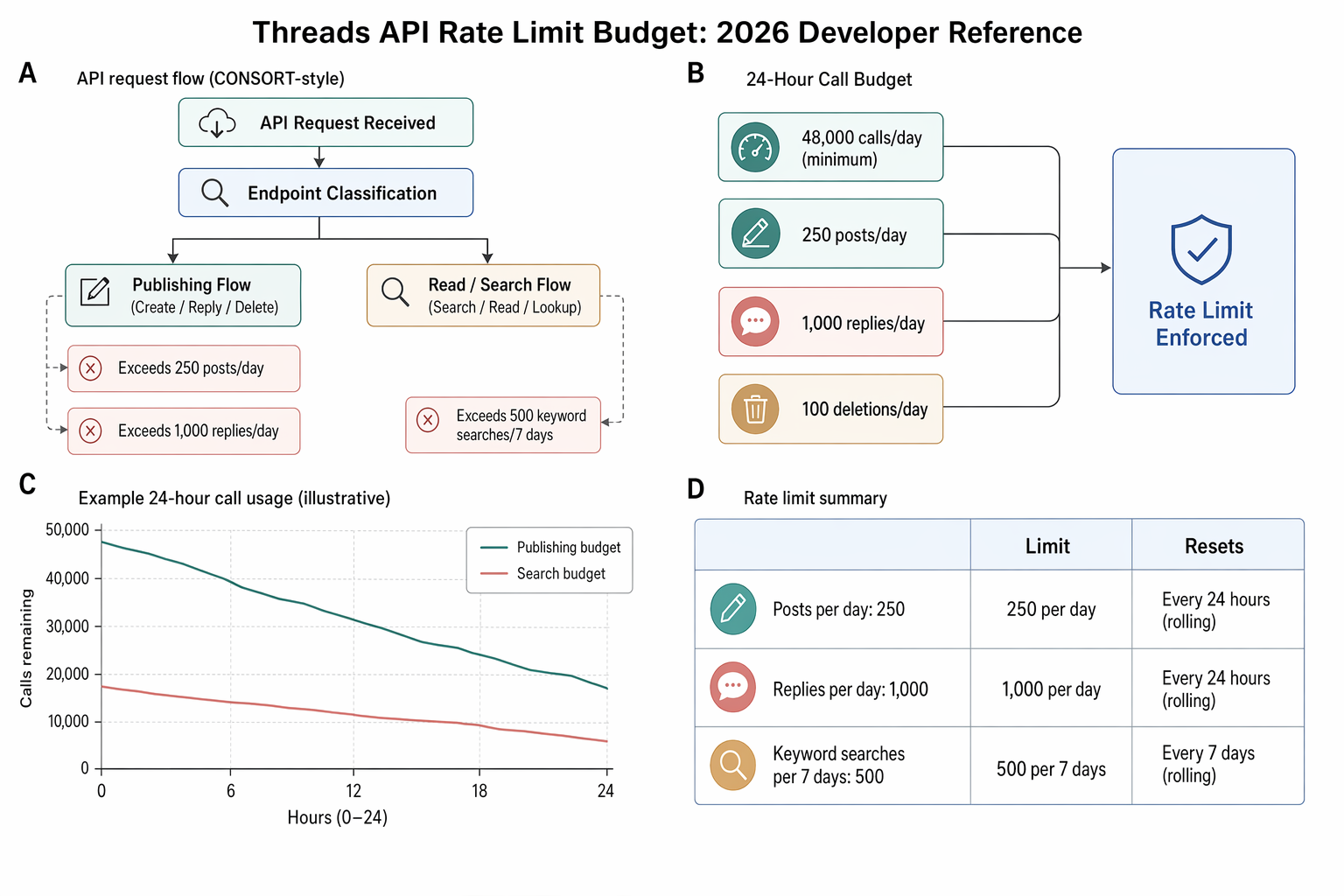
The headline formula is simple: calls per 24 hours equals 4,800 multiplied by your account's impression count, with a minimum impression floor of 10. That means a brand-new account, with zero followers and zero impressions, still gets 48,000 API calls per 24-hour window. A modest account with 100,000 impressions per day has 480 million calls available. The maths is generous on its face.
But the call budget is not the binding constraint. The publishing caps are. Per profile, per rolling 24 hours, you get 250 posts, 1,000 replies, 100 deletions and 500 location searches. A carousel of 20 items still counts as one post against the 250 cap, an important detail for anyone building a media-heavy scheduler.
Keyword search has the tightest cap of all: 500 queries per rolling 7-day period. That is roughly 70 queries a day if you spread them evenly. For a research or listening product, that is a hard ceiling, not a soft one.
The asymmetry is the real story. Publishing is generous, search is rationed, and the rate limit you actually hit depends entirely on what you are building. A posting bot will live inside the limits forever. A monitoring product will hit the keyword search wall by Tuesday.
What can you build with the Threads API today?
The honest taxonomy of Threads API products in 2026 is small. There are roughly four shapes, and most production apps are one of them.
Schedulers and publishers. The largest category by volume. Hootsuite, Sprout Social, Sprinklr, Grabyo, Social News Desk and Techmeme were beta partners from day one. The pattern is identical across all of them: queue content, render media, two-step publish, store the returned media ID, poll insights on a schedule. The n8n community has been trading working configurations in public since launch.
Inbox and reply management. With threads_manage_replies and the reply webhooks added in October 2024, you can build something close to a Threads-native inbox: hide, unhide, respond, and route. Real-time webhooks mean you no longer have to poll.
Insights and reporting. The insights endpoints expose views, likes, replies, reposts, quotes and shares per post, plus follower count and demographics at account level. The data is good, the lookback window is short, and you will want to warehouse it yourself.
Research and monitoring. This is where the official API runs out of road first. Keyword search at 500 queries per 7 days is enough for a curiosity dashboard, not a product. Public mentions retrieval helps for branded monitoring of your own profile, but it does not give you general listening across topics. For breadth, you reach for a third-party API.
What you cannot build on the official API: a cross-platform search engine, a bulk extraction pipeline, a Threads-wide trend detector, or anything that needs to read other people's content at scale. Deliberately out of scope, and Meta is unlikely to widen the aperture.
How does the official Threads API compare to third-party Threads APIs?
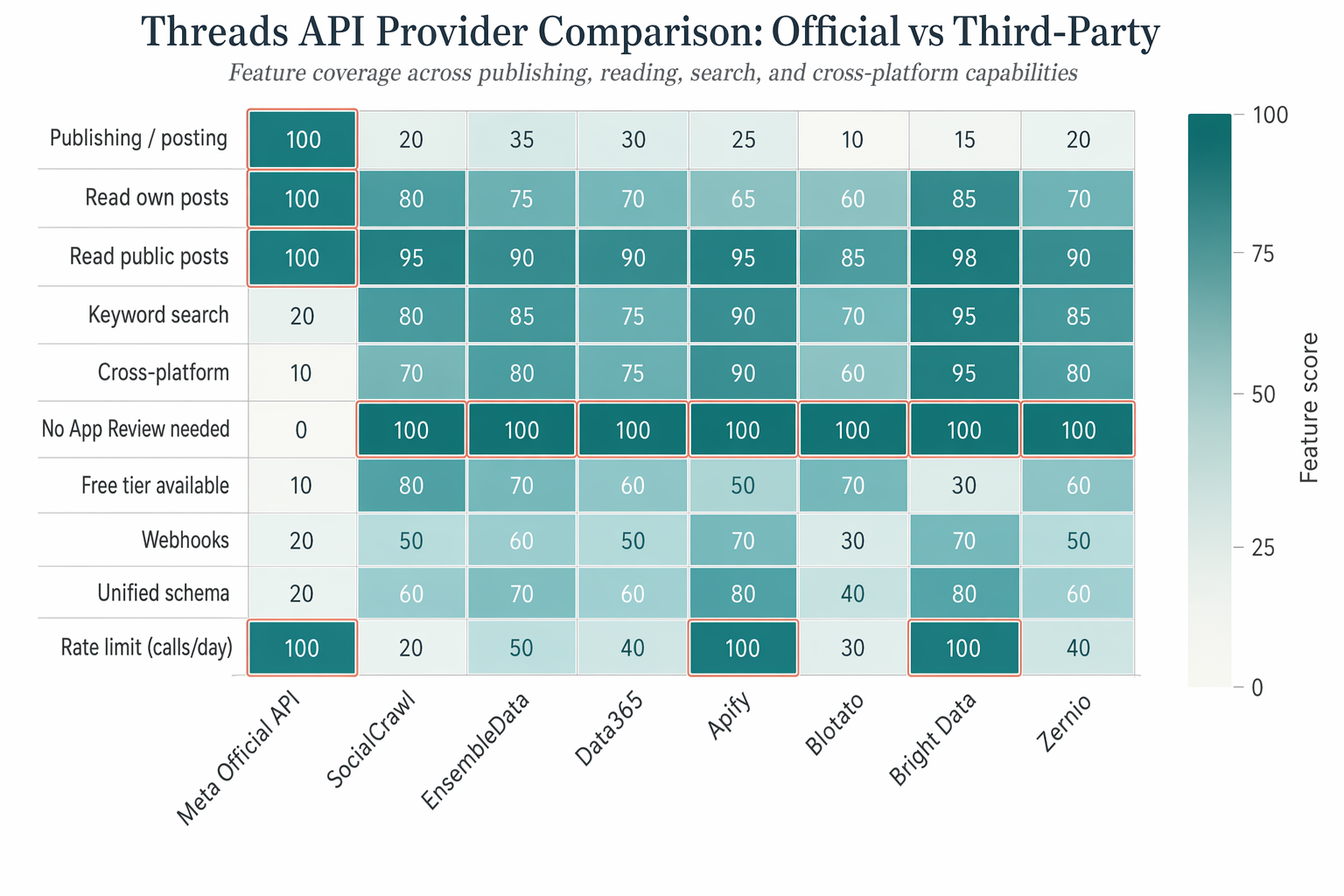
The honest split: the official API is for writing, third-party APIs are for reading at scale. You will probably want both.
Meta's API is free in dollars and expensive in calendar time. Every permission scope needs to pass Meta App Review, with screencasts, a privacy policy, and frequently business verification. First-round rejections add roughly a week per cycle, and most teams budget two to four cycles per scope.
Third-party Threads APIs trade dollars for time. EnsembleData starts at a free 50-units-per-day tier and scales to about $1,400 per month for high-volume extraction. Data365 charges £300 per month for Basic and £850 per month for Standard. Apify and Bright Data offer general-purpose scraping infrastructure but no Threads-specific schema. Zernio targets the same "unified social API" angle. Blotato wraps Meta's OAuth and App Review behind a single endpoint for publishing.
SocialCrawl sits in this layer too, but with a deliberately different shape: read-only public data on Threads as one of 43 platforms covered by a 321-endpoint unified API. Every Threads response comes back in the same envelope as Reddit, X, TikTok, Instagram, YouTube and the rest, with engagement_rate, estimated_reach, content_category and language computed server-side. No App Review, no OAuth juggling, $0 free tier with 100 credits. Source posts, not summaries.
The choice is not which API to pick. It is which problems sit where: publishing on Meta's API, reading and cross-platform listening on a unified API.

What does Meta App Review really cost a developer?
App Review is the bottleneck nobody costs into their roadmap. Here is the actual calendar cost, not the docs-page version.
Each permission scope is submitted separately, with a screencast that shows the end-to-end user flow, a hosted privacy policy, terms of service, and, for any scope touching publishing or insights, business verification of the legal entity behind the app. Reviews typically take 2 to 7 working days per scope. First-round rejections run at roughly 60 to 70 per cent, mostly for cosmetic reasons: screencast missing a step, privacy policy URL returning a 404, business verification documents in the wrong format.
The realistic budget for a four-scope production app (threads_basic, threads_content_publish, threads_read_replies, threads_manage_insights) is three to six weeks of elapsed review time. It does not parallelise cleanly because reviewers sometimes want to see the previous scope working before approving the next.
Two patterns shorten the cycle. Ship in development mode against invited Testers as long as possible, and only submit when the flow is production-shaped. Record screencasts with narration that maps each step to the documented scope description. Reviewers reward boring, literal videos.
The misconception that trips up indie developers most: you do not need App Review to build, you need it to ship. In development mode, you and any invited Tester can use every scope freely. That is fine for a personal automation or an internal tool. It is not fine for a public product, and the moment you flip the toggle is the moment App Review begins.
How do you read Threads data at scale without App Review?
If your job is to read public Threads content rather than post to it, the official API is the wrong starting point and a third-party scraping API is the right one.
The straightforward Threads-only option is EnsembleData's dedicated scraping API, which exposes profile, post, comment, search and hashtag endpoints with sub-5-second response times and no Meta account requirement. Good if Threads is the only platform you care about.
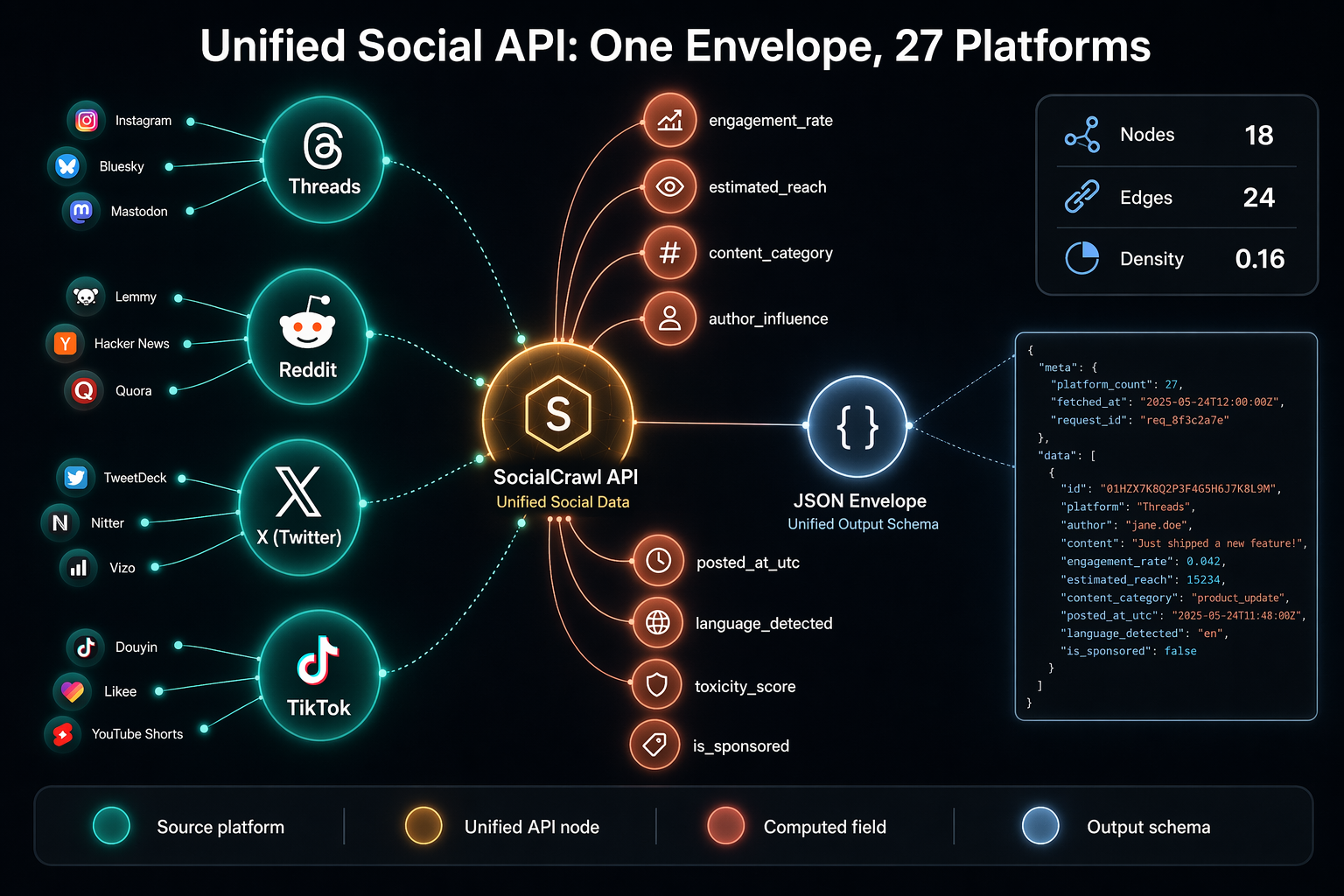
The unified option, and the one we are biased towards, is to treat Threads as one platform inside a broader social-data graph. SocialCrawl returns Threads posts, profiles, replies and search results in the same JSON envelope as Reddit, X, TikTok, Instagram, YouTube and 36 other platforms. Every response carries success, platform, and a data object with content, author, engagement and metadata, plus computed fields like engagement_rate and estimated_reach. One schema, every platform. The walled garden between Threads, Reddit and X disappears at the API layer.
The rule of thumb: if you can answer a research question with 500 keyword queries a week, use Meta's API. If you need to listen across topics, regions, languages or competitors, use a unified API. If you need both, do both. For the September 2026 read-path update — multi-window search yield, post comments, and filled carousel / video media — see the Threads scraper capability tour.
Where does the Threads API fit alongside Reddit, X, and TikTok data?
The useful mental model is not Threads as a standalone surface but as one node in a walled-garden bridge. Each platform is a fortress with its own auth, schema and rate limits. Threads, Reddit, X, TikTok, Instagram, YouTube and the rest do not talk to each other. Your product probably has to.
The practical pattern is parallel cross-platform queries on a single keyword or entity. A pre-meeting briefing pulls the top engagement-ranked posts about a company from Threads, the 1,500-upvote Reddit thread on r/webdev, the 3.6M-view TikTok video, the top HN comment and the most-quoted X post, all in one API call returning one schema. A breaking-news monitor watches the same five surfaces for the first mention of a product launch. An AI agent fetches all of it through a single MCP tool, with no per-platform OAuth or API key juggling, courtesy of npx -y socialcrawl-mcp.
That is the gap the official API is not trying to fill. Meta gives you Threads. You still need a bridge to the other 34 walled gardens. The question is not whether to use the Threads API. It is what to put around it.
Use Meta's API for the things only Meta can do (publishing, account insights, reply moderation). Use a unified, multi-platform API for everything else (reading, searching, listening, comparing). Both, not either.
FAQ
Is the Threads API free to use? Meta's official Threads API has no published paid tier or per-call fee. The real cost is calendar time: every permission scope requires Meta App Review, typically 2 to 7 working days per scope with a high first-round rejection rate. Third-party Threads APIs charge in dollars but skip App Review: EnsembleData from free (50 units a day) up to about $1,400 per month, Data365 from £300 per month, SocialCrawl from $0 with 100 free credits.
Can I use the Threads API without a Facebook or Instagram account? You need a Meta developer account, which can be created with any Facebook login. You do not need an Instagram Business Account or a linked Facebook Page. You do need a Threads profile connected to the user whose content you are publishing or reading.
How long do Threads API access tokens last? Short-lived tokens expire in one hour. Long-lived tokens expire in 60 days and can be refreshed between 24 hours and 60 days after issue. Permissions granted by users with private Threads profiles expire after 90 days regardless of token state, on a separate clock.
Can I search public Threads posts by keyword?
Yes, with the threads_keyword_search scope, but the limit is 500 queries per rolling 7-day period (roughly 70 a day). For higher-volume search, third-party APIs are unrationed by Meta's cap.
Does the Threads API support webhooks?
Yes. Real-time webhooks for reply events were added in October 2024, and webhooks for public mentions arrived alongside the threads_manage_mentions scope. Both remove the need to poll, and both require the underlying scope to pass App Review before production traffic is permitted.
Related posts

AI Content Detector API: 1 of 233 Human Posts
An AI content detector API that flags 1 of 233 human posts and catches 77% of AI posts. Filter a feed or score one text. 91% of AI posts of 40+ words caught.

Audience Questions on Social Media: 120 Already Asked
We listed 120 audience questions on social media. 109 of those rows are comments. Sorted into who, what, why, how, and vs. Comment language is not a country.

Best TikTok Analytics Tools: 5 of 16 Absent
5 of 16 metrics were absent on 17 October 2026. 18 accounts, 180 posts, the smallest at 2,077,115 followers. A separate play count was absent on every post.